Choosing a Replacement Nib: Width, Specialty Grinds, and Flex
By NibPath . 7 min read . Updated June 2026
A nib is the single most controllable variable in how a fountain pen writes, and changing the nib size or grind is the most direct way to change your writing experience without buying a new pen. The TWSBI Replacement Nib Unit drops into a TWSBI ECO or 580 in seconds and opens the full range from EF to 1.5mm stub. The Jowo Size 6 Replacement Nib Unit fits dozens of brands if your pen uses the Jowo size 6 unit. This guide explains what to choose for your handwriting style, paper, and writing goals.
Quick answer
Choose a nib based on your handwriting size, paper, and writing goal. Extra-fine and fine nibs work on most papers and are best for small handwriting. Medium and broad nibs show shading and shimmer best. Stub and italic nibs add calligraphic line variation. Flex nibs require practice and slow strokes. Start with F or M before moving to specialty grinds.
This guide contains affiliate links. NibPath may earn a commission at no cost to you.
Understanding nib size designations
Nib size labels (EF, F, M, B, BB) refer to the width of the line the nib lays down, not the physical size of the nib unit. But these designations are not standardized across brands: a Japanese M nib writes closer to a European or American F. Pilot's M nib, for example, writes a noticeably finer line than a Lamy M nib.
As a starting rule: Japanese pens from Pilot, Sailor, and Platinum run one size finer than their European counterparts. A Pilot F writes like a European EF. A Lamy M writes like a Pilot B. If you are coming from ballpoints or fine-liners, start with an F nib from a Japanese brand or an EF from a European brand for the closest approximation.
The TWSBI Replacement Nib Unit is one of the few direct comparisons you can make easily, since TWSBI offers EF through 1.5mm stub in the same drop-in unit format. Buying an EF and an M unit for the same pen costs less than a second pen and lets you directly compare how line width affects your writing experience.

TWSBI Replacement Nib Unit
A drop-in replacement nib unit for TWSBI ECO, 580, 580ALR, and Diamond 580 pens. Available in EF, F, M, B, 1.1mm stub, and 1.5mm stub. Swaps without tools in seconds by unscrewing the grip section.
Fine and extra-fine nibs: the practical choice for most writing
Extra-fine and fine nibs write a narrow line that works on almost any paper, including lower-quality office paper that would feather badly under a broad or stub nib. They are the right choice for small handwriting, dense note-taking, or any situation where paper quality is unpredictable.
The tradeoff is that EF and F nibs show less ink shading, less shimmer sparkle, and less tonal depth than broader nibs with the same ink. Pilot Iroshizuku Tsuki-yo Ink in an EF nib looks flat compared to the same ink in an M nib on Rhodia paper. If showing off ink properties is part of your enjoyment, move up one size.
For calligraphy practice and lettering, an EF or F nib is too narrow to show italic line variation effectively. Use the Pilot Parallel Pen Italic Nib Set instead, which is purpose-built for calligraphic line variation at 1.5mm to 6.0mm widths.

Pilot Parallel Pen Italic Nib Set
The replacement nib units for the Pilot Parallel Pen calligraphy system, available in 1.5mm, 2.4mm, 3.8mm, and 6.0mm widths. The Parallel Pen uses a dual-plate nib system that produces crisp italic lines and accepts all standard international cartridges.
Stub and italic nibs: calligraphic line variation for daily writers
A stub nib is ground with a flat, rounded tip that produces a wide horizontal stroke and a thin vertical stroke, giving any handwriting a subtle calligraphic character without requiring deliberate pen angle. The TWSBI Replacement Nib Unit in 1.1mm stub is the most accessible entry point: it drops into any TWSBI ECO or 580 and immediately changes the look of your writing.
An italic nib has the same flat profile but with sharper, square corners that produce crisper line variation but require consistent pen angle to write smoothly. The Jowo Size 6 Replacement Nib Unit is available in cursive italic grinds from specialty nib workers for pens that accept the Jowo size 6 unit.
Stubs and italics are more demanding of paper quality than round-tipped nibs. Use them on Rhodia or Clairefontaine paper where the smooth surface lets the flat tip glide without catching. On lower-quality paper, the corners of an italic nib catch fibers and produce a scratchy, inconsistent experience.
TWSBI Replacement Nib Unit
A drop-in replacement nib unit for TWSBI ECO, 580, 580ALR, and Diamond 580 pens. Available in EF, F, M, B, 1.1mm stub, and 1.5mm stub. Swaps without tools in seconds by unscrewing the grip section.
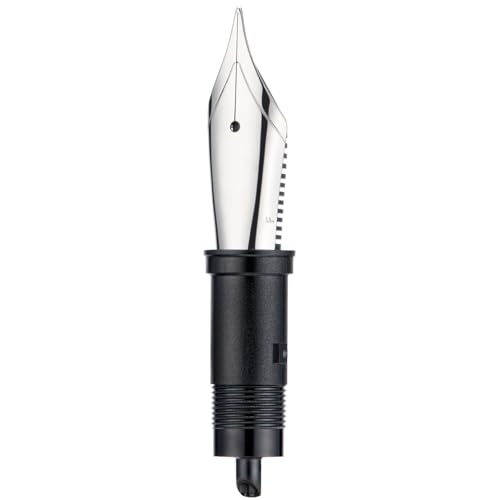
Jowo Size 6 Replacement Nib Unit
The industry-standard Jowo size 6 nib unit used in dozens of pen brands including Edison, Franklin-Christoph, Opus 88, and others. Available in EF through 2B, stub, cursive italic, and oblique grinds from a variety of retailers.
Flex nibs: real line variation with real patience
A flex nib produces wide swells on downstrokes by spreading the tines apart under pressure, then returning to a narrow line on upstrokes. The effect is dramatic and the calligraphic results are genuinely beautiful. It also requires completely different writing habits: slow, deliberate downstrokes, no side pressure, and generous ink flow.
The Noodler's Ahab Replacement Flex Nib is the most affordable dedicated flex nib in the fountain pen market. It fits the Noodler's Ahab and Konrad pen bodies and delivers genuine flex when used correctly. The community-standard caution applies: forcing the tines apart faster than the ink can flow causes railroading, where the tines spread but the ink channel empties and you get two-line strokes with a white gap between. Practice on smooth paper with a wet ink like Robert Oster Fire and Ice Ink before committing to a piece of correspondence.
Gold nibs flex more naturally than steel nibs because gold is softer and more spring-like. If you want the flex experience without the railroading risk, a vintage or modern gold flex nib on a dedicated pen is the long-term path. The Noodler's Ahab Replacement Flex Nib is the right starting point before that investment.

Noodler's Ahab Replacement Flex Nib
A steel flex nib sized for the Noodler's Ahab and Konrad pen bodies. Provides genuine flex line variation with a slow, deliberate drawing motion. Requires patient break-in but delivers calligraphic line width variation unavailable from rigid nibs.
Featured in this guide
TWSBI Replacement Nib Unit
A drop-in replacement nib unit for TWSBI ECO, 580, 580ALR, and Diamond 580 pens. Available in EF, F, M, B, 1.1mm stub, and 1.5mm stub. Swaps without tools in seconds by unscrewing the grip section.
Jowo Size 6 Replacement Nib Unit
The industry-standard Jowo size 6 nib unit used in dozens of pen brands including Edison, Franklin-Christoph, Opus 88, and others. Available in EF through 2B, stub, cursive italic, and oblique grinds from a variety of retailers.
Pilot Parallel Pen Italic Nib Set
The replacement nib units for the Pilot Parallel Pen calligraphy system, available in 1.5mm, 2.4mm, 3.8mm, and 6.0mm widths. The Parallel Pen uses a dual-plate nib system that produces crisp italic lines and accepts all standard international cartridges.
Noodler's Ahab Replacement Flex Nib
A steel flex nib sized for the Noodler's Ahab and Konrad pen bodies. Provides genuine flex line variation with a slow, deliberate drawing motion. Requires patient break-in but delivers calligraphic line width variation unavailable from rigid nibs.
Related roundups
FAQ
Frequently asked questions
Can any nib be replaced on any fountain pen?+
No. Nib replacement is only straightforward when the pen uses a hot-swappable nib unit or a standard nib unit size shared by multiple brands. Proprietary single-piece nibs pressed into a feed (like most vintage and many modern high-end pens) require tools and expertise to replace. Research your specific pen model before purchasing any replacement nib.
What does it mean if my nib writes dry?+
A dry nib lays down less ink than expected, producing a lighter, paler line than other nibs with the same ink. Causes include a tine gap that is too narrow from the factory, a feed that is not primed, or a genuinely dry ink formulation. Try a wetter ink first before adjusting the nib physically, since a wet ink resolves most dryness complaints without any nib work.
Is a gold nib worth the price for a daily writer?+
For a pen you use for two or more hours of writing daily, the cushioned springiness of a gold nib reduces writing fatigue in a way that steel cannot fully replicate. For occasional or light use, the writing quality difference does not justify the price premium. Buy the best paper and ink you can afford first; the nib upgrade pays dividends only after the writing environment is optimized.